
Orchard Park Resident Lookup Sources
Official records each answer a narrow question. None of them profiles every person in town. The Erie County parcel system earns its keep when you already know an address, because it splits the parcel's situs from the owner's mailing field. A recorded deed then ties a legal party to an instrument and a date. Court and voter records play different roles again. Treat every result as a dated association, and reach for a second source type before linking it to an Orchard Park resident.
| Record | What It Confirms | Where | Access |
|---|---|---|---|
| Parcel and assessment roll | Current owner, situs, owner mailing, and tax association | Erie County Real Property Parcel Search | Free online; an owner is not necessarily an occupant |
| Deed, mortgage, or lien | Recorded party, instrument, legal description, and transaction date | Erie County Clerk BrowserView | Index and image limits apply; no official address search |
| Voter registration | Requested registration fields, status, and geography | Erie County Board of Elections FOIL form | Written request under Election Law limits; protected voters withheld |
| Court docket | Party role, case type, filing, status, and appearance information | WebCivil Local and NYSCEF | Sealed or restricted matters may not display |
| Vital index or copy | Birth, death, or marriage event and name | New York State Department of Health | Certificates are restricted; older genealogy routes have separate rules |
| Directory or yearbook | Dated listed address, spouse, occupation, or event clue | Buffalo and Erie County Public Library | Historical source, with gaps and OCR errors |
Match the entry point to what you already hold. An address calls for a parcel-first search. Save the SBL or PIN, owner name, book and page, and roll date exactly as printed. A name calls for an official party index. A dated street directory or a carefully described records request can also work. A license or entity result shows an affiliation, not a private residence. The same caution covers a court party or a tax mailing recipient.
Orchard Park Name Search Paths
A name and an address pull in different directions. Address questions belong to the Erie parcel record and On-Map. Record the SBL or PIN exactly. Then carry the current owner and book or page into BrowserView. The Clerk's official-record index cannot be searched by property address. Name questions should start with a party search or a dated directory hit. An address counts only once a record shows it. History adds its own lane. An old directory, a voter-registration directory, a newspaper, or an obituary helps. It sets the right period from the start.
- Write down the full name, alternate spelling, municipality, and date range. Keep Orchard Park Town and the separate Village of Orchard Park distinct when the custodian matters.
- For an address, search the county parcel system, save the situs and mailing fields separately, and capture the parcel's SBL or PIN.
- Use the owner, book and page, instrument number, or parcel key in BrowserView. Search a party name as last name followed by first name, without a comma.
- For a name, search a full form and a surname with first initial where the portal permits it. Record the query, filters, source date, and returned role.
- Confirm the match with two non-identical attributes, such as street and middle initial, spouse and year, or SBL and recorded party. Do not select the most convenient result when records conflict.
County parcel data can place an Orchard Park situs beside a mailing city somewhere else. That gap is a record relationship, not an error. Dated directory entries add context. So can a lawful election record. A current parcel layer, though, proves nothing about whether a historic person still lives at that address.
Note: A date on a parcel roll, recording, directory, or docket marks when the record was current, never when a person moved.
Orchard Park Court Lookup Fields
Case research starts with WebCivil Local. The portal searches parties in eligible local civil cases. Filters cover party name, attorney, judge, plaintiff or defendant role, court, case type, filing year, status, future appearances, sort order, and HTML or PDF output. Use the court and year together. That pairing separates people who share a name. A court type never describes where a person lives, and a docket entry alone proves nothing without a disposition.
| Result Field | What It Can Show |
|---|---|
| Court and index number | Where the matter is filed and the identifier to preserve for clerk follow-up |
| Case type and filing date or year | The type of matter and its recorded timing |
| Plaintiff, defendant, attorney, and judge | Named parties and roles, which should not be read as residency proof |
| Status, appearance date, and future appearance indicator | Docket status information that may change as the court updates data |
| Address or court location and output | Displayed contact or venue detail plus available HTML or PDF result |
The NYSCEF guest case search opens with Case Identifier, Name, Tax Cert or SCAR, and New Cases tabs. Case Identifier takes a full case number. An attorney file number or third-party index number works too. Date filters run on paired start and end dates. Guest access does not promise full visibility. Confidential, sealed, newly entered, or restricted documents may be absent.
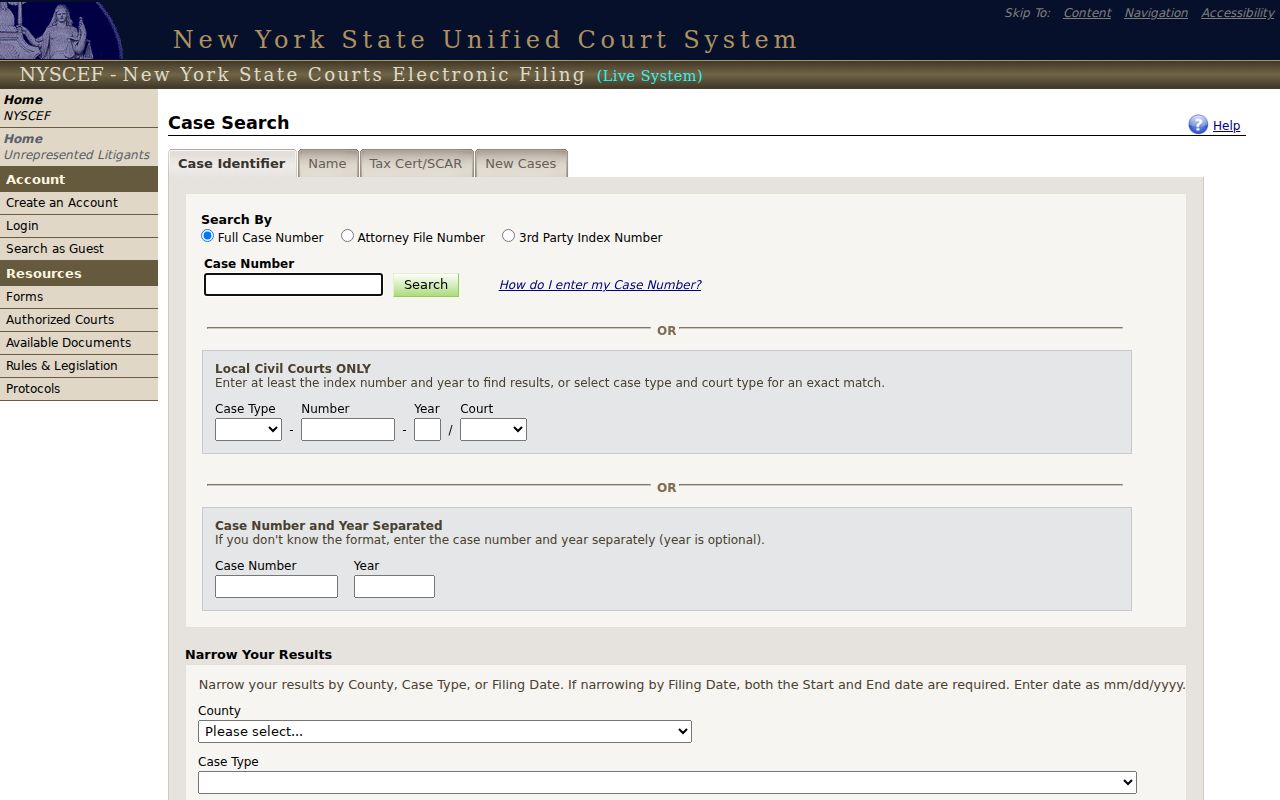
Treat the search result as a research note. The case identifier belongs in a request to the proper clerk. The court, year, and party role does too. A screen result is never the whole case file.
Estate questions turn to WebSurrogate, which supplies name, file, old-index, index-book-page, and will searches. Images are filed online only for files dated on or after February 19, 2014. Older unrestricted files sit at courthouse public computers. Estate papers may name heirs or fiduciaries. Heirship is not current residency. Restricted documents stay restricted.
Orchard Park Voter FOIL Route
Erie County publishes no stable name-based voter screen. Neither does Orchard Park. The documented route is the Erie County Board of Elections FOIL form. It asks for the town, ward, or district, plus format, party selection, field selection, sort order, and time period. A narrow request beats a broad-list grab.
| Request Choice | Documented Use or Limit |
|---|---|
| Town, ward, or district | Defines a narrow geographic request and is distinct from ZIP or parcel geography |
| Address, phone, date of birth, gender, and history | Selectable request fields, not a guarantee that each field appears in every export |
| Paper, Access, Excel, DBF, or CSV | Formats listed on the form, with advance-payment and reproduction terms |
| Party, status, and voting history | Requestable subject to the form and law; ballot choice is not a public field |
Election Law sections 3-103(5) and 3-220 set the rules. Registration data access follows them directly. Confidential registrations under section 5-508 sit apart, and sensitive identifiers face redaction. The Board form also carries a no-direct-or-indirect-commercial-use certification, so keep the geography and years tight and describe the existing record rather than a guessed portal.
Verifying an Orchard Park Resident
Verification means testing a candidate against separate records, not gathering every field on offer. A parcel result can support legal ownership. A recorded deed backs the transaction trail. A dated directory, a permitted voter record, or a public filing can then support an address association for one period. Court, license, and entity entries should keep their actual role labels. A person can appear as a party, representative, or professional. They may not live in Orchard Park at all.
- Anchor a name to a source, date, and relationship. Keep an owner, mailing recipient, listed resident, and court party in separate columns.
- Check a second official or dated source that supplies a different attribute, such as SBL, street, spouse, middle initial, occupation, court role, or year.
- Use the relevant portal's exact filters and retain the record identifier, search spelling, result count, and any image or access limit.
- When evidence conflicts, ask the custodian for the underlying existing record or a certified copy if the law permits it. A missing image is not permission to infer its content.
- Docket
- A court's running list of case events and status information. It is not proof of a final outcome unless the disposition clearly says so.
- Index
- A search list of record identifiers and fields. An index entry can point to a document without including the document image.
- Image
- A scanned or electronic view of the underlying record. Portal access may require an account, a public terminal, or clerk inspection.
- Certified copy
- A copy issued and authenticated by the lawful custodian. Eligibility, fees, and restrictions depend on the record type.
A single historical lead often starts at the Grosvenor Room. The Grosvenor Room sits inside the Buffalo and Erie County Public Library. Its shelves hold Erie voter-registration directories arranged by town. The runs span 1926 through 1971. They sit alongside yearbooks, newspapers, and other directory series. Work through the period that matches your era. Avoid stretching a modern address backward into those decades. The Orchard Park Directory Book walks through those historical runs in far more depth.
Orchard Park Affiliation Records
Official New York filings sometimes carry a name. That is one way a dated affiliation surfaces. The Department of State entity database lists an entity name, organization date, jurisdiction, and county. It also shows the service address, registered agent, and status. County Clerk DBA and assumed-name filings carry their own dates and roles. Record whether the result names an officer, agent, filer, or entity. A service address is never a home address.
The State Education Department professional-verification search needs a profession. It also needs at least three surname letters. Results can include a name, profession, license number, and location. They also list original date, registration status, and any discipline summary. Computerized history before the mid-1980s can be incomplete. Treat these as affiliation and status records only. They are not residency records.
An official filing works best as one piece of identification evidence. It gains value when the name, role, date, or location matches something else you hold. Never lean on it alone for an Orchard Park address association.
Orchard Park Vital Index Boundaries
The Orchard Park Town Clerk handles births and deaths that occurred within the Town. A current Orchard Park address does not make the Town the custodian of the event. The Town publishes no public local name index. It also publishes no online marriage or death image portal. For records outside New York City, the Department of Health is the state route. It also serves statewide divorce certificates. FOIL cannot override certificate eligibility rules.
Genealogy requests fall under the State's 75, 50, and 50-year windows. Births open after 75 years when the subject is known deceased. Deaths open after 50 years, and marriages after 50 years when both spouses are known deceased. The Department of Health form asks for the subject's name and variants. It also asks for event details, parent names where applicable, search years, relationship, and proof. A $22 fee covers one to three search years. Processing can run eight months or longer. Confirm the current form before sending payment.
The New York State Archives supplies indexes, not certificates. Outside New York City, its coverage includes births from 1881 to 1937. Marriages run from 1881 to 1960. Deaths run from 1880 or June 1880 to 1960, with gaps in early registration. The Grosvenor Room keeps vital index microfiche and regional newspaper materials too. A restricted certificate, a no-record-found reply, and a record held elsewhere are three distinct outcomes.
Note: Sealed adoption information belongs with the authorized Department of Health adoption route, not ordinary vital-index research.
Orchard Park Resident Lookup Privacy
New York's Freedom of Information Law, Public Officers Law Article 6 sections 84 through 90, opens a route to existing agency records. It does not force an agency to build a resident dossier. The official New York FOIL guide explains that agencies may deny requests amounting to an unwarranted invasion of personal privacy. Court records answer to Judiciary access rules, not a FOIL demand. Restricted or sealed matters may never reach online results.
The New York Address Confidentiality Program gives eligible participants a substitute mailing address under Executive Law section 108 and 19 NYCRR Part 134. Never reverse a substitute address into a physical one. Confidential voter registration is protected as well. The federal DPPA restricts DMV personal information. Do not publish full dates of birth, identification numbers, private contact details, protected-victim information, or an inferred current address.
A wrong record gets fixed by its custodian. That means the Town Clerk, Assessor, Erie County Clerk, Board of Elections, Department of Health, or court clerk. It depends on which record is in error. Keep the source, date, and stated relationship intact as you go. That approach respects both a valid public record. It also respects the people whose information may be incomplete or protected.