
Orchard Park City Directory Holdings
Orchard Park's historical directory trail is centered at the Buffalo & Erie County Public Library's Grosvenor Room. The shelf is important because the library guide does not present one uninterrupted annual run for the Town. It instead directs researchers to East Aurora, Buffalo Southeast Suburban, Buffalo Southtowns, Buffalo South Suburban, and East Hamburgh titles. That cross-reference is a finding, not a filing error. Bring the year, the spelling found in the record, and any street or occupation detail when asking for a volume.
| Collection | Years | Where Held | Access |
|---|---|---|---|
| Orchard Park, East Aurora, and suburban directory series | 1950-2004, selected runs | Grosvenor Room, Buffalo | Closed-stack retrieval and call-number cross-references |
| Buffalo City Directory and address books | 1828-present; address books 1883-1916 | B&ECPL and New York Heritage | Microfilm, noncirculating originals, and selected scans |
| Reverse, criss-cross, and Haines directories | 1883-present, selected runs | Grosvenor Room | Address-to-name lead with gaps by series |
| Erie County voter directories | 1926-1971 | Grosvenor Room and Board of Elections route | Town-arranged historical enrollment records |
| Buffalo newspapers and local maps | Evening News 1881-present; Courier Express 1926-1982 | B&ECPL, Library of Congress, and library map holdings | Microfilm, digital material, and map context |
These collections have real gaps. Buffalo material can be useful for a person connected to the wider region, but it is not proof that the person lived in Orchard Park. The digitized Buffalo run covers 77 volumes from 1832 through 1913, while the later Town material appears through selected suburban series. Keep the printed title, volume year, call number, page, and the relationship the source actually states. A missing volume or an absent name is not enough to prove a move.
Orchard Park Directory Geography
The City Directory label is a page convention. The legal local government is the Town of Orchard Park, and the incorporated Village of Orchard Park is a separate municipality within it. That distinction matters when a dated entry leads to a permit, tax, court, voter, or vital-record question. Confirm whether the source is speaking about the Town, the Village, Buffalo, or a regional publication before sending a request to a custodian.
Older wording needs the same care. The area appears in records as Hamburg, East Hamburg, East Hamburgh, and later Orchard Park. The village was known as Orchard Park in 1882, formally acquired that name in 1921, and the Town was renamed in 1934. A directory may use its own coverage boundary rather than a legal boundary. Search the period spelling first, then use the date, map, and legal-description context to decide whether two entries belong to the same place.
Grosvenor Room Directory Access
The Grosvenor Room at the Buffalo & Erie County Public Library is at 1 Lafayette Square, Buffalo, NY 14203-1887, and its phone is (716) 858-8900. It is the documented regional route for historical directories, voter volumes, newspapers, yearbooks, maps, church and cemetery material, and genealogy databases. Most materials do not circulate. Closed-stack items are retrieved by staff, so call ahead about appointments, camera rules, reproductions, and database access before making the trip.
For the Orchard Park shelf, state the year and series rather than asking only for "the Orchard Park book." The library guide includes the 1950 East Aurora reference, the 1956-1957 Who's Who call number, East Aurora volumes for 1964-1966, Buffalo Southeast Suburban for 1966-1979, Buffalo Southtowns for 1983-1994, and Buffalo South Suburban for 1996-1999, 2003, and 2004. It also says to see East Hamburgh. Staff retrieval is the normal access channel when a title is not out on an open shelf.
Orchard Park Directory Reading Guide
A directory entry is a compact, dated description. The 1881 Buffalo example in the library collection shows a name, occupation, employer or office, the h. home marker, a street address, and a page. Not every volume has every field, and the format can change by publisher or year. Copy the page citation before interpreting the abbreviations. An address could be a home, office, boarding place, business, or telephone subscriber address, depending on the series.
| Name | Transcribe the printed spelling and initials. Compare variants before merging same-name entries. |
|---|---|
| Occupation | A role or trade that can distinguish two people with the same name. It does not establish a home address by itself. |
| Employer or office | A workplace or office clue that may lead to a newspaper, business, or organization record for the same period. |
h. home marker | The marker identifies the home portion of this scanned example, followed by the stated address. |
| Address and page | Keep the street, number, publication year, and page together so another reader can check the image. |
- Criss-cross directory
- A reverse-address section arranged by street or address, used to locate a listed name from a known address.
- Householder index
- An alphabetical name section that points to a listed household or head of household in a particular volume.
- Abbreviation key
- The volume's explanation of shortened terms and marks. Photograph or transcribe it before reading individual entries.
The 1881 Buffalo City Directory scan shows why the page image matters as much as searchable text.
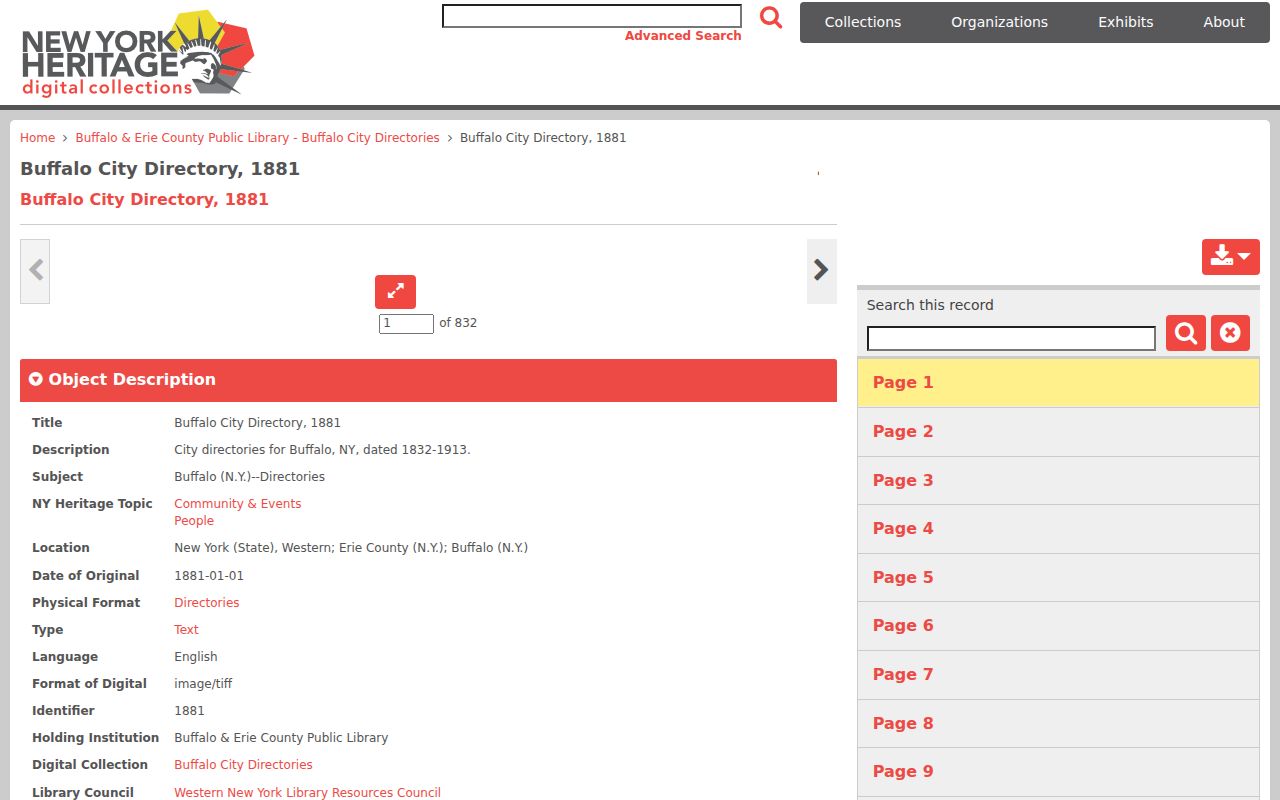
Use the scan to check the lettering, column order, and h. marker whenever an OCR result seems uncertain. The entry is a Buffalo example and should be treated as a model for reading fields, not as an Orchard Park residence claim.
Buffalo Directory Scans and OCR
New York Heritage supplies selected digitized Buffalo directory volumes from 1832 through 1913. The library's digital collections support Collection, Keyword, Boolean, and Exact searches, with item, file, and collection filters. Search a surname with a spouse, occupation, street, church, school, or historical town spelling when a simple name search returns too many hits. Open the actual page for every possible match.
OCR is an aid, not a transcription. Type, column breaks, initials, and old street names can be read incorrectly by an automated search. A good citation retains the collection, year, page, printed name, and image URL. If an entry is only a regional or Buffalo hit, say so. The historical trail becomes stronger when another source for the same year, such as a voter directory, map, newspaper, or deed, supports the geographic connection.
Orchard Park Reverse Directories
Address-first research uses a different shelf. Buffalo's reverse-address series begins in 1929, Buffalo Address Books have a reverse section for 1883-1916, and the Courier Express has a reverse phone directory for 1931. The Haines Directory covers all Erie County from 1968 to the present. These series can offer a dated address-to-name clue that the regular alphabetical volume cannot provide as quickly.
Read the reverse listing, then find the name in the standard alphabetical section and compare the two entries. Record whether the page identifies a resident, business, boarder, or subscriber. Telephone books add another series: Bell runs from 1886-1975 with 1952 missing, Frontier from 1904-1914, NYNEX from 1976 onward, and Talking Phone Book runs for 1988-1995 and 1998 onward. None is a continuous record of every household.
Maps Beside Historical Volumes
Maps help turn a directory street into its period setting. The Library of Congress Orchard Park map is a three-sheet September 1920 resource. B&ECPL also lists Sanborn material for Dewell's Corners in 1928 and 1928-1938. Use these sheets to understand a street, lot, building footprint, depot, farm, or nearby place name at the time of an entry.
A map does not name an occupant. It is context for a dated directory, deed legal description, or newspaper notice. This matters where older sources describe Windom, Orchard Park station, a farm, or Dewell's Corners instead of a modern street number. Compare the source's own words before attempting to equate a historic address with a modern parcel.
Orchard Park Directory Timeline
The available timeline is a set of overlapping collections rather than one publisher's uninterrupted local run. It shows why a household search may need to change shelves as the decades change.
- 1832-1913: selected Buffalo directory volumes digitized through New York Heritage.
- 1883-1916: Buffalo Address Books with a reverse section.
- 1926-1971: Erie County voter directories arranged by town.
- 1929-present: Buffalo City Directory reverse-address section.
- 1950-2004: selected East Aurora and Southtowns references for Orchard Park research.
- 1968-present: Haines Directory coverage for Erie County.
Publication title changes do not necessarily mean the household moved. The library's East Aurora and suburban cross-references often describe the publisher's regional coverage. Cite the printed series, then use a period map and the source date to keep a geographic conclusion modest.
Tracing Orchard Park Directory Households
For family history, begin with the earliest confirmed entry and work forward. An annual volume can show when a surname, occupation, or address first appears in a particular series, but annual listings are not a full census. Pairing it with other dated records limits mistaken assumptions about a move, marriage, or death.
- Find the earliest plausible listing and record its title, year, page, spelling, and stated address.
- Follow the name in the next available volume, noting changes in address, spouse notation, occupation, or town spelling.
- Use a reverse or criss-cross section when the historic street is known, then compare the alphabetical entry.
- Pair the directory year with the nearest released federal census and the town-arranged Erie voter directory when available.
- Check newspaper, yearbook, map, and deed or parcel sources around a change, preserving the date and relationship shown by each.
The most recent federal census remains subject to the 72-year release rule, so directories and newspapers fill many of the years between census releases. A disappearance from a series might reflect a gap in holdings, a different title, a renamed place, an unlisted household, or an actual move. Check the next available source before drawing a conclusion.
Newspapers After Directory Gaps
When a directory line stops, B&ECPL's newspaper holdings offer the documented follow-up route. The Buffalo Evening News runs from 1881 to the present, and the Courier Express runs from 1926 to 1982, with older titles available in microfilm or other formats. Search with the name, date range, address, occupation, school, church, or place-name variant already found in the city directory.
Keep the issue date, page, title, and what the notice actually says. An obituary may identify a former residence, a family relationship, or a service location instead of a current home. No single official Orchard Park obituary index was located, so newspaper microfilm and clipping files are the responsible regional route. The Town's searchable minutes reach back to 1996, but they are a record of municipal business, not a resident roll.